
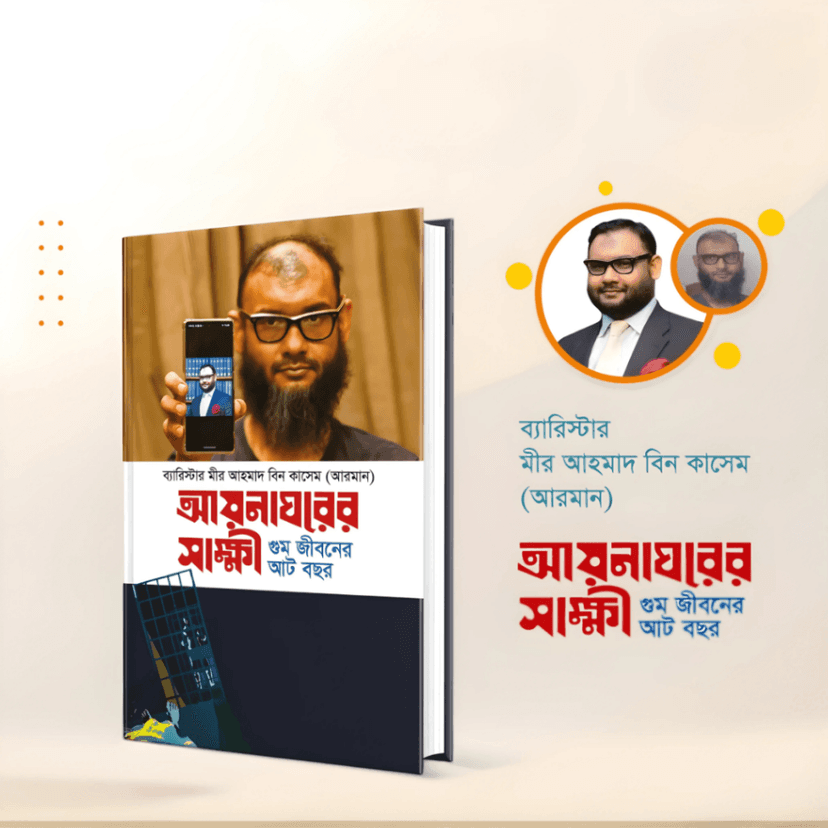
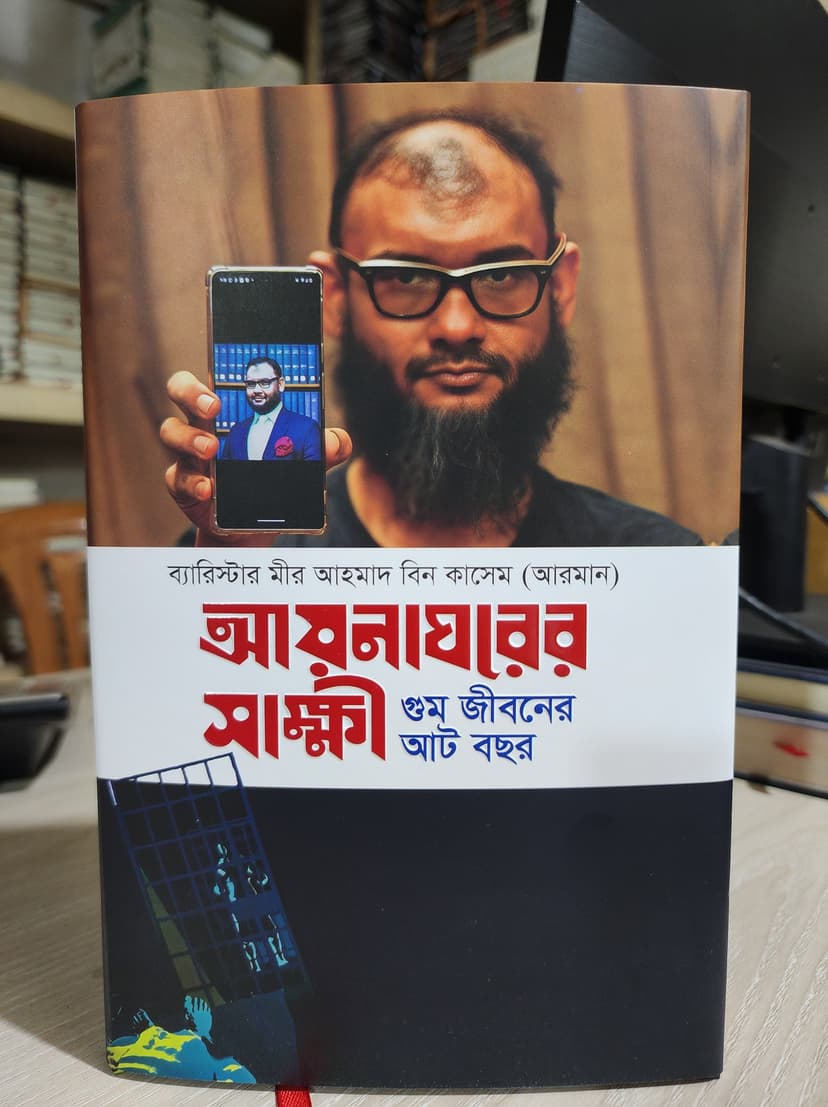
আয়নাঘরের সাক্ষী
Eight Years of a Life in Enforced Disappearance

লেখকের কথা
Infinite gratitude to the Almighty Rabbul Alamin, who has brought me back to a life of freedom. To the martyrs and the injured of the unforgettable July Movement—whose sacrifices served as a source of inspiration for my release—I offer my deepest respect, prayers, and heartfelt gratitude.
The primary inspiration behind my decision to write a book about the arduous experiences of my prison life came from my mother. She is a wise and perceptive person. Being a writer herself, she understands the sense of responsibility that writing demands. She always told me that my life experiences could become a testimonial document. From the experiences of my captivity, many may find strength to deepen their faith in Allah and in humanity. At the same time, some may gain the courage to remain steadfast against oppression. Encouraged by my mother, I finally decided to write.
When I began working on this book, I was severely ill. Although I had returned to freedom, the long and inhumane eight years of detention had taken such a toll on my body and mind that I did not even have the strength to hold a pen. Meanwhile, time was passing relentlessly. Naturally, the more time passes, the less compelling any issue appears. Therefore, I felt an urgency to begin writing immediately.
Eventually, my family stepped forward. On their advice, I narrated my memoirs, which were recorded as audio. The arduous task of transcribing those recordings was taken on by my elder sister and co-author of this book, Hasin Siddika Nilu.
Taiheba and her husband—my brother-in-law, Dr. Saiful Islam—worked day and night to complete the task meticulously. Throughout the entire writing process, Dr. Saiful Islam devoted his time, managing everything from coordinating with the author to building bridges with the publisher. I was further assisted by my daughter, Ben Sumaiya Rabeya, a PhD researcher in Malaysia, and her tireless supporter Abdullah. Overall guidance was provided by my younger sister, Tohera Hossain, and her husband, Mukhlis Hossain, a PhD researcher at KUBI. With their active support and advice, the book was completed.
I extend special gratitude to those who encouraged me from different parts of the world through phone calls, messages, and emails to write my memoir and share the story of my captivity. They informed me of many unknown aspects related to the themes of my writing. I will never forget their selfless encouragement. Sharing the unbearable days of my captivity is my responsibility—so that people may know how, even in a world of oppression, Allah granted me the strength to continue serving faith and religion. If even one person draws inspiration to endure a life of faith from this book, that alone will be its success, Insha’Allah.
I would like to clarify one important matter. ‘Aynaghar’ has now become a symbolic term. It is widely used to refer to secret detention centers. However, from a legal or institutional standpoint, ‘Aynaghar’ specifically refers to the secret detention facility of the Directorate General of Forces Intelligence (DGFI). Other detention facilities had different names. I was detained in three separate facilities. I was held in a cell operated by RAB, known as the ‘TICAFI Cell.’ The full form of TICAFI is Tactical Force Interrogation. Its formal name is not ‘Aynaghar.’ However, since the term ‘Aynaghar’ has become commonly used to mean secret detention center, the word has been used in the book’s title for ease of understanding. I mention this for the awareness of conscious readers.
The days of my captivity were not very diverse, but they were extremely distressing psychologically. Almost every day was a harsh experience. Thus, over eight long years, the memories condensed into a limited collection of intense recollections. Another issue was that for a significant period of my detention, I had no sense of time. I was held in a place where it was impossible to distinguish between day and night. After many days, through prolonged experience, I slowly learned to estimate time—particularly by observing variations in meal schedules. I could also infer time somewhat from careless conversations among the guards. Based on these estimated times, I structured my recollections. Even while writing, it was difficult to specify exact dates, and determining timelines objectively—from the earliest days—took nearly a year. Within this timeless psychology of detention, isolation, and uncertainty, I experienced much, and I have consciously maintained narrative continuity to explain events as accurately as possible.
Finally, I humbly request readers to inform me if they notice any errors or inconsistencies in my presentation. Insha’Allah, these will be corrected in future editions. I express my heartfelt gratitude to everyone who assisted, encouraged, and took responsibility for the publication of this book. May Allah accept all of our efforts. Ameen.
Barrister Mir Ahmad bin Qasem (Arman)
12 August, 2025
ভয়াল রাতের শুরু
After entering the house, washing my hands and face, we were preparing to sit down together for a meal when suddenly there was a knock at the door—knock, knock! After a few seconds’ pause, the door was struck violently. The clock showed 11:30 PM.
I rushed to the door and tried to look through the keyhole to see who was outside. I saw 8–10 tall men standing there. Instantly, I realized—they were the same people who had been following me all day in a microbus.
My wife and family members were already aware that I had been receiving warnings from various places. They immediately understood that the people waiting at the door had come to take me away. My younger sister, with remarkable courage, said, ‘Brother, we will not open the door. Let them show a warrant. If necessary, let them break the door. Even then, we will not open it ourselves.’
Echoing my sister, my wife firmly agreed. Both of them covered their faces with cloth and bravely moved toward the door. An unknown fear gripped me. As a lawyer, I had seen firsthand how recklessly law enforcement personnel could behave in court premises. In cases of misconduct, they make no distinction between women, children, or the elderly. If I did not cooperate and they broke into the house, they might humiliate me and the women in my family. I did not want such a situation to occur in front of my children, as it would instill severe fear in their tender minds.
I had always anticipated that I could be arrested at any moment, but I never imagined it would happen like this. Still, I was mentally prepared for arrest. I stopped my wife and sister and said, ‘No, creating such a situation right now is not appropriate. I will open the door. Once I’m taken to the police station, I will see you there.’
Our door has a chain attached, which allows it to open slightly but not fully. This is called a chain lock or security hook. I fastened the chain and opened the door just a little.
Keeping my voice as calm as possible, I asked, ‘Who are you?’
They replied, ‘You will have to come with us. We have some matters to discuss with you.’ I asked again, ‘But who are you? I do not see any uniform; you are in plain clothes.’
Just a few days earlier, the Supreme Court had issued a directive stating that no one could be arrested without proper identification or uniform. I pointed this out. They were all tall men. The one who appeared to be a senior officer had a weapon hanging from his waist. The others were also armed. Some of the weapons had serial numbers clearly visible to me.
Their tone then became harsh: ‘These rules do not apply to us. You must come with us.’ Their words and body language made it clear that if I refused, they would take me by force. Compelled, I said, ‘Please wait a moment. I will get ready.’ Saying this, I closed the door in front of them…